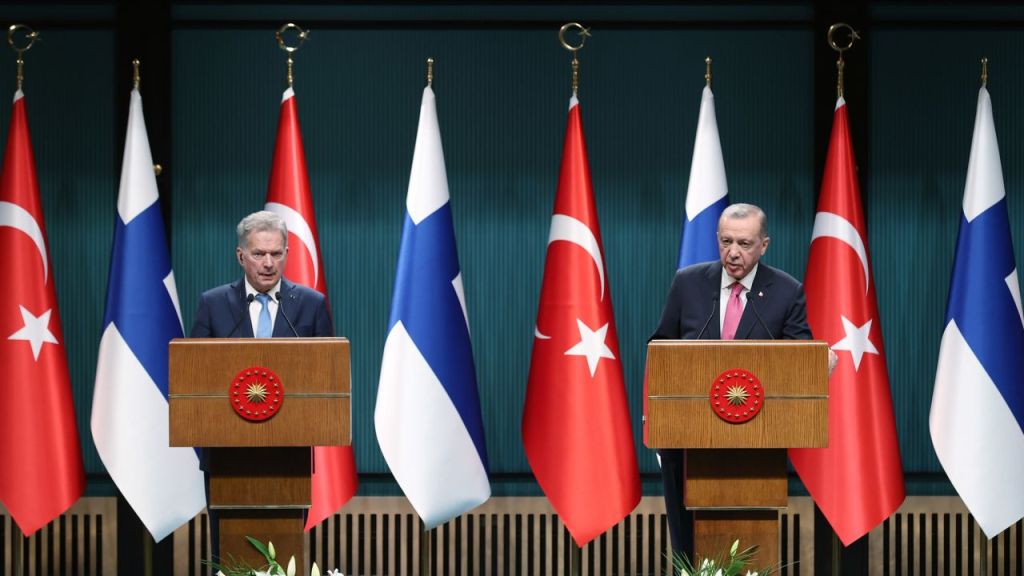
Turkey is preparing to approve Finland’s NATO membership with the visit of Finnish President Sauli Niinistö. President Erdoğan emphasized that Turkey had to consider Finland’s NATO membership separately due to Sweden’s failure to fulfill extradition requests in the context of terrorism, and said he hoped that the membership would take place before the elections. By taking this maneuver vis-à-vis Sweden, Ankara has proved that it was more constructive than an obstacle to NATO enlargement. In fact, Sweden, unlike Finland, with which it started out as a concomitant member, was pursuing a strategy aimed at pitting Turkey against NATO, and was even obliged to do so.
Sweden’s NATO Strategy after the Paludan Incident
In the aftermath of the far-right extremist Rasmus Paludan incident, Sweden’s strategy in the context of NATO and Turkey was to confront Turkey with the 28 member states that had approved Sweden and Finland’s accession. On Friday, January 27, Swedish Foreign Minister Tobias Billström stated that his country had fulfilled the conditions for NATO accession demanded by Turkey and was “close to the point where the Turkish parliament can start the ratification process,” but this statement reveals traces of Sweden’s strategy after the Paludan incident.
In the same statement, Billström also noted that “the speed with which the 28 NATO member states have approved Sweden and Finland’s accession process is ‘unprecedented’”. With this statement, Turkey is presented as an obstacle to this “unprecedented development” and Sweden has removed itself as an interlocutor and pointed to Turkey as an “obstacle country” to the 28 NATO members.
In addition, it should be emphasized that the refusal to fulfill some “extradition requests” from Turkey is presented as a decision of the Swedish Courts and not of the Swedish government. This Swedish discourse aims to draw a framework that distinguishes Turkey from other NATO countries in terms of “values”. It should also be noted that this discourse has succeeded to some extent.
Sweden was aiming to draw a framework for NATO and the 28 member states that ratified its accession with “unprecedented speed”: In our country, which is based on the principle of separation of powers, our membership is being blocked on the pretext of an incident, no matter how disrespectful, in the context of “freedom of expression”, a problem that started with people whom we did not extradite to Turkey in accordance with court decisions. In short, it aimed to act with the rhetoric of “Turkey is blocking my membership because I share the same values as you”. The dictionary equivalent of this goal was to position Turkey outside the meaning world of NATO.
On the other hand, the Swedish government was forced to adopt this strategy after the Paludan incident due to its domestic political balance. In fact, the Swedish government led by Ulf Kristersson is a three-party minority government that needs the far-right Sweden Democrats to survive. Jimmie Akesson, leader of the Sweden Democrats, whose support the Prime Minister needs, accused the Prime Minister of “kowtowing to Erdoğan”. Moreover, a poll conducted in January 2023 showed that most of the Swedish people felt that “too many concessions have been made to Erdoğan”.
In other words, the prevailing view among the Swedish people was that the government had handled NATO “very badly”. In addition to this view, Swedes have concerns about “energy prices, climate, health and gangs”. This means that the Swedish government, which has a fragile structure, has serious concerns about public support. Therefore, on NATO, the Swedish government’s only option for survival was to shirk responsibility and pit Turkey against the 28 NATO countries.
The Meaning of Ankara’s Nordic Maneuver
Above all, by separating Finland’s membership from Sweden’s position, Turkey has prevented a strategy aimed at excluding itself from NATO values and policies. This maneuver can be said to have largely frustrated Sweden’s strategy, which means this maneuver prevented Sweden’s policy of shifting all the responsibility from itself and pitting NATO and Turkey against each other.
Regarding the membership of Sweden and Finland, to which NATO attaches particular importance, Turkey has also responded to Western analyses that accuse it of being “a NATO ally increasingly acting under Russian influence”. In these analyses, Turkey was accused of being an “unpredictable country” and questioned whether it shared Western concerns and values. With this maneuver, Turkey seems to have made a serious move to dispel these question marks.
In the coming period, Sweden will have to remember its responsibility in the face of Turkey’s demands. Of course, the condition for this is for Turkey to be able to explain this maneuver of Turkey to the Western public opinion at the institutional level that it cares about NATO enlargement. In this process, the Ministry of Foreign Affairs needs to be more prominent at the institutional level. Turkey has made a move that will make it no longer an “unpredictable country” for its NATO allies. For this move to bear fruit, an institutionalized and consistent foreign policy seems essential.
(This analysis was written on March 15, 2023)


 ADEM YILMAZ, DR.
Yorum bırakın