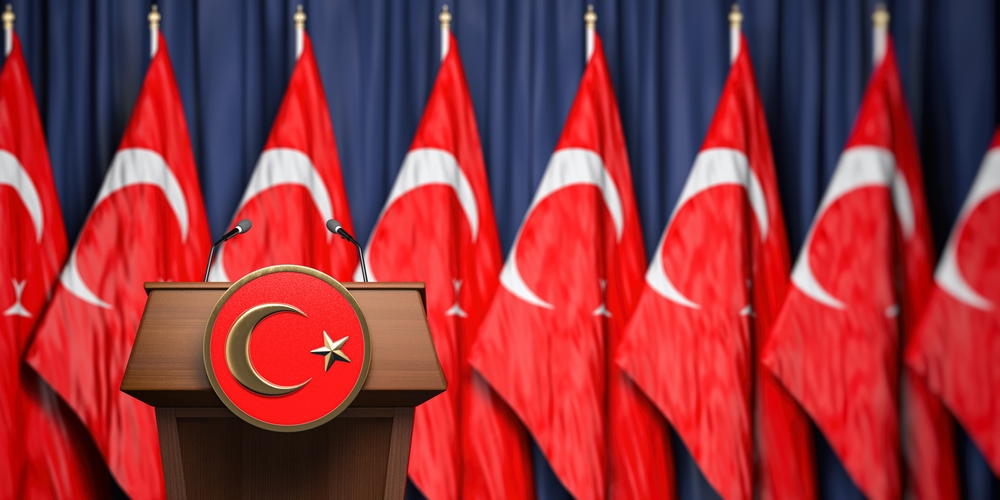
Turkey is about to choose between the 21-year rule of the AK Party and Recep Tayyip Erdoğan and Kemal Kılıçdaroğlu, the presidential candidate of the National Alliance, which has consolidated a significant opposition. Despite the perception that Erdoğan is facing the toughest election of his rule, the opposition alliance, whose strategy is to be Erdoğan’s antithesis, does not have an easy job.
The president’s party is still leading in all polls, despite a significant backlash against Erdoğan, including high inflation and a lack of coordination in the early days of the earthquake. There is no shortage of polls showing Erdoğan ahead of his rival Kılıçdaroğlu in the race for the presidency. The Turkish President, who has insisted on a third term, put on a show last Sunday at a rally that attracted 1,700,000 people.
But the most interesting aspect of the May 14 elections is this: The majority of the votes to be cast for both Mr. Erdoğan and Mr. Kılıçdaroğlu will be based on “lack of choice”. While the psychology of those who will vote for Mr. Erdoğan will largely favor him due to the lack of alternatives, the majority of the votes for Mr. Kılıçdaroğlu will be shaped by the understanding that “I will vote for whoever is against Erdoğan”.
Kılıçdaroğlu’s Advantage Changing Sociology
Kılıçdaroğlu’s biggest advantage is the changing sociology. In particular, the process of “leaving religion” experienced by the children of religious-conservative groups has secularized their view of life and their expectations. Consequently, the events that took place during the AK Party era and shaped young people’s view of religion paved the way for a secular generation in Turkey, replacing a secular-repressive state with a generation on the path to secularization.
This secularization, inadvertently caused by the AK Party and the religious people that it has brought to the center, could make Kılıçdaroğlu the President of the Republic based on the reaction against the AK Party alone.
Another expression of this understanding is that the reaction against Erdoğan and his 21-year rule has intensified to such an extent that it trivializes who the opposing candidate is. The majority of young people, especially those who grew up under the AK Party’s rule, see it as unnecessary to even question who Erdoğan’s opponent is or the candidate’s post-election performance.
“Erdoğan Despite Erdoğan” Sentiment May Operate
The understanding of “Erdoğan despite Erdoğan” has two main pillars. The first one is the distrust in both Kılıçdaroğlu as a political figure and the CHP. The source of this distrust is the negative image of the CHP among conservative and right-wing voters. Kılıçdaroğlu is generally seen as a “leader who has failed to win elections” and this image is reinforced by the accusation of his “lack of charisma”.
The other main pillar is the fragmented and fragile structure of the Table of Six that makes up the Millet Alliance. Having experienced a crisis during the candidate selection process, the Table of Six does not give a positive impression of its decision-making processes. This fragility is a serious determinant, even if the enthusiasm of the opposition public does not allow for a discussion of this issue.
Moreover, the Millet Alliance’s capabilities and post-election performance raise questions, especially among voters over the age of 35, and Erdoğan is preferred to this uncertainty.
Conclusion
Analyses that read the elections in Turkey as a competition between “those who want democracy” and “those who support the authoritarian regime” are quite erroneous. Indeed, voter behavior in Turkey cannot be understood within this classification.
Likewise, there are masses with these two tendencies both among Erdoğan supporters and those who are considering voting for him and among Kılıçdaroğlu supporters.
The main motivation of voters is the opponent and his/her capacity rather than their own candidate. This motivation is more prevalent in the opposition. In other words, in a way, it is the “badness” of the opponent, i.e. the lack of choice, that will lead both leaders to victory.
May 14th elections will be decided by lack of options.

 ADEM YILMAZ, DR.
Yorum bırakın